
I’m stuck in line, running late. New Year’s rush at the store -everyone knows this chaos. Behind me stretches an endless queue: a mom with two kids, an elderly couple, a delivery guy (always in a hurry), two teenagers (rolling their eyes, scrolling on their phones)… The cashier is struggling with the system, working slowly, and is not friendly. I feel tension rising in my chest—I know this feeling. One more moment, and some sharp remark will escape my mouth.
And then I do what I often do, what I enjoy doing, and what I share as knowledge at every opportunity—and today, with you through this text.
Instead of letting that frustration pull me under, I stop. I see what’s happening—with me, with her, and with the people around us. I look at her. I notice how tired she is, probably working for hours in this New Year’s madness. I decide to change direction. I look her in the eyes and say: “I see how tired you are. Have you had a break? I hope your shift ends soon and you get to rest during the holidays.”
She flinches. Lifts her gaze, at first in disbelief. She’s met with my warm look, complete of understanding and support. Her expression changes. She smiles at me, a bit shyly but still. The entire space shifts—not just for me, not just for her, but for the people behind me in line. The energy changed. The whole situation transformed.
This wasn’t just my internal transformation. This was relationship alchemy.
That Brief Pause That Changes Everything
Viktor Frankl’s writing has deeply influenced my work and way of thinking. Among other things, he wrote:
“Between stimulus and response, there is a space. In that space is our power to choose our response.”
That pause, that space between what happens to us and our reaction—that’s the place of our deepest power! Buddhist teachers call it “bare awareness” and describe it as the ability to see what’s happening without identifying with what we SEE.
Modern psychology goes further. Emotional alchemy shows how we can transform basic emotions into nobler forms—for example, fear into courage, jealousy into self-compassion, anger into compassion.
Let’s go one step further…
What Is Transmutation and How It Changes Every(thing)
The word “transmutation” comes from alchemy – the ancient practice of turning lead into gold. In psychological terms, it’s the transformation of one emotional or mental state into another—from destructive to constructive, from reactive to creative.
From prisoner to creator. From commodity to maker.
However, most stories about transmutation stop at our personal transformation.
All existing models – from Buddhism to psychology, focus on how YOU transform YOURSELF, how YOU change your thoughts, your emotions, your reaction.
That’s powerful. But it’s not (good) enough.
Life doesn’t happen in a vacuum. You’re not alone on an island. You live in a web of relationships: with your partner, kids, colleagues, boss, friends, and even that cashier at the supermarket.
There must be a better way: good for you & good for every(one).
When you transform not just your inner energy but the energy of the entire situation (and everyone sharing it), when you turn poison into medicine not just for yourself but for everyone around you—that’s relationship alchemy. That’s the shift from intra-personal (within me) to inter-personal impact (between us).
That’s progress, and that’s what interests me!
4 Levels of Awareness and Transmutation
Let me break down what this looks like in practice. I’ve mapped four levels on which we can function—from complete powerlessness to complete power.
Two key dimensions of this model are awareness (how conscious we are of what’s happening) & alchemical potential (how much we actually transform the situation and how).
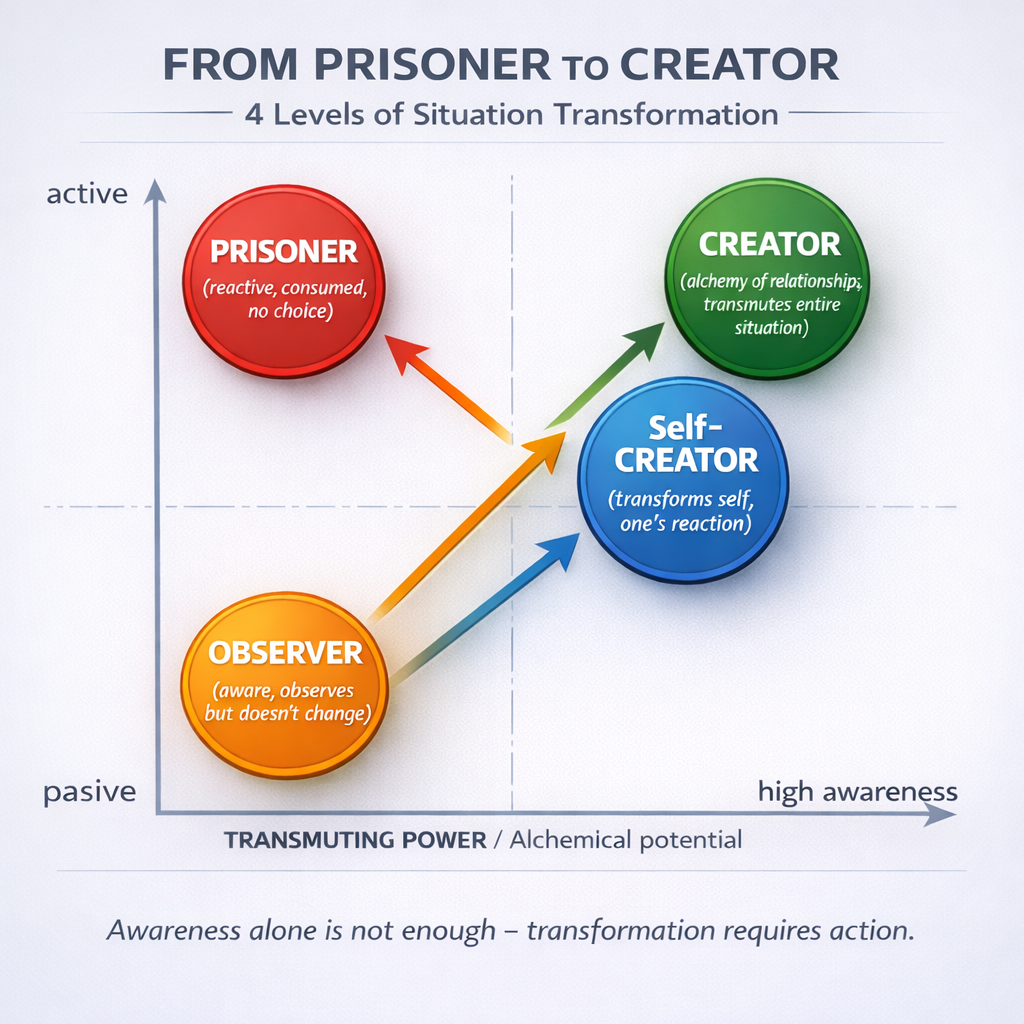
Prisoner Level
You have no clue what’s happening to you emotionally, and it doesn’t even occur to you that you could do something to change the situation for the better—for yourself and others.
The event completely consumes you. There’s no pause between stimulus and reaction. You function like an animal, impulsively. You ARE active, but destructive. You act, attack, and defend, but you don’t transform anything. You fire off your raw emotion without any filter. The event has imprisoned you; you don’t exist separately from it, and you don’t influence it in any way.
Cashier slow? Automatic anger, automatic snapping. A colleague criticizes you at a meeting? Automatic defense or counter-attack. Partner says something wrong? Immediate escalation and bickering.
The business reality is that most business decisions are made HERE. In panic, under pressure, from ego-protection. Reactive, impulsive, without transmutation. Later justified by the thinking brain, our rationalization: “Of course I decided that way, anyone would react like that! He reacted that way, too. He deserved it.”
Observer Level
If you’re at this level, you’re aware of yourself in the event. You see what’s happening, you notice your emotions, but you don’t do anything with them. You are PASSIVE. Buddhist “bare awareness”, a feeling arises, you see it, it releases or integrates on its own.
Unlike the Prisoner, who is active (but destructive), you don’t act at all.
“Anger is rising. I notice it.” But you don’t do anything further. “I see I’m pulled in.” But you don’t change your reaction. “Whatever will be, will be.”
You have dignity, inner peace. But you don’t change yourself or others. Passive awareness. A quiet observer who doesn’t participate in creation. The world around them stays the same, and they themselves are in a negative emotion, not outside of it. They don’t allow it to imprison them.
Self-CREATOR Level
At this level, not only do you see what’s happening, but you actively transform your reaction. You change your experience, your thoughts, your emotions. You turn anger into boundaries, fear into courage, and jealousy into self-reflection. This is the first level of true transmutation.
Cashier slow? You notice anger, choose understanding, tell yourself, “Maybe she’s tired, it’s not about me or because of me.” A colleague criticizes you? You notice defensiveness; choose curiosity; ask, “What’s valid in that criticism?” Partner says something that throws you off? You see anger, determine context, and tell yourself, “Maybe they don’t understand me best.”
Now we’re at the level of situation transmutation and relationship alchemy! Now we’re dealing with magic!
The difference is clear: The Prisoner acts but doesn’t transform, fires off reactively. The observer doesn’t act or transform; it just watches. Self-CREATOR acts & transforms—but only themselves.
This is a good place, but it’s not the best we can do!
CREATOR Level
At this level, not only do you transform yourself, but you also transform the energy of the entire situation and everyone involved. Your action becomes the antidote for the whole system. You don’t just work on yourself; you work on yourself and WITH the world around you.
Cashier slow? You notice anger, transform it into care, help her, and ask if she’s tired. She smiles, and the whole line relaxes. A colleague criticizes you? You notice defensiveness, transform into openness, thank them, and ask for details and clarification. The meeting becomes constructive for everyone. Partner says something uncomfortable? You notice anger, transform it into understanding, and help them express what they meant. The relationship deepens.
Magic!
This is what I call relationship alchemy.
Be Creator, Not Prisoner
Let me share an ordinary situation that can happen to anyone- it happened to my friend yesterday.
Scene: January 1st. A woman gets in the car, dressed for a winter walk, and drenched in Moka coffee! The entire pant leg is wet. Husband beside her: “Are you really that clumsy?! Is this possible?! And what did you do to the car?!”
Five degrees outside. The trip just started. Wet pant leg. Husband angry. Stain huge.
She DECIDED. In that moment. No. A coffee stain won’t dictate her mood.
“We assign meaning to events and situations. The fact that I spilled coffee doesn’t mean I’m missing a brain cell; it means I’m human, and well, I missed and spilled coffee on myself. Plus who’s ever seen such a big coffee stain?! People will think it’s a design!”
She transformed the meaning. Changed her experience. Stopped being a commodity, a passive consumer of others’ expectations, an object that takes hits. Became the creator of her experience.
And she didn’t stop there.
“My husband was angry until he realized nothing happened to the car, and the only one suffering any consequences was me with a wet pant leg in 5-degree weather. And that spilled coffee doesn’t make you a messy person. So he softened and started laughing. When he saw it’s OK to laugh in situations like this and let go of the pressure of perfection, he started having fun too.”
She didn’t just transform herself. She transformed her husband, too. She transformed the energy of the entire situation: from tension and anger to laughter and lightness. From poison to medicine—for both.
That’s relationship alchemy in practice, in one small detail. And her story, which she shared with me, inspired me to put my thoughts on this topic on paper. Thank you, dear T ?
Be CREATOR & create. Don’t be a prisoner and a commodity trapped in reactivity, without choice.
3 Practical Steps: How to Start With Relationship Alchemy
STOP
Recognize What Level You’re On. Before you do anything, ask yourself:
- Am I consumed? (Prisoner)
- Or just observing? (Observer)
- Or transforming myself? (Self-CREATOR)
- Or transforming myself and the space around me? (CREATOR)
Practice: For the next 7 days, every time you feel a strong emotion (anger, fear, frustration), stop and mentally note: “This is level X.”
Awareness is the first step. A necessary step. But not the last.
ACT
Action Is Transmutation. Awareness without action is just Observer. True transmutation requires an act. But not just any act—one that transforms both you and every(thing) around you.
Practice: Choose one situation this week, no matter how small, and actively change it. Cashier rude? Be kind. Partner closed off? Be curious. Colleague critical? Be open.
And observe what happens not just with you, but with others.
NOTICE OTHERS
What Level Are the People Around You On? The best way to practice recognizing your own position is to observe others.
Colleague explodes at a meeting? Prisoner. Friend stays silent and watches but doesn’t participate? Observer. Boss transforms their frustration into a constructive approach? Self-CREATOR. Partner not only solves their problem but changes the energy of the entire situation? CREATOR.
Practice: This week, observe 3 people in your surroundings and try to position them through these four levels. Don’t judge them, just notice: “This is level X.” The more you recognize where others are, the easier it is to become aware of it in yourself. And then ask yourself: What level would I be at in that situation? What level do I want to be at?
In Closing
Relationship alchemy both is and isn’t magic. It’s not a positive thinking trick. It’s not ignoring reality. But it transforms something into something completely different.
When we function as Prisoner, we’re just a puppet of stimulus and reaction—slaves to our impulses. When we’re Observer, we see the play but don’t take part in it. When we’re Self-CREATOR, we change ourselves—we stop being COMMODITY (a passive thing) and become creators of our own experience.
But when we’re CREATOR, we change every(thing)!
Start with one situation. Start with one transmutation.
Start. Be aware & make everything in you & around you the best it can be! A lot around us should be better, but a lot can be better through our doing.
 2020
2020
Comments