
For decades, I’ve been saying the same thing in different ways: we can all do it. We can do as much as we want. If we want it badly enough, we’ll find a way. They tell me I’m an alien. That I’m not a valid example. That I have no right to claim this, because I’m me and others are others. That I’m special, different, made of different clay.
But I never gave up on that idea. Because in my work with thousands of people, I’ve seen the same thing over and over: some who have nothing more than others — no more talent, no more money, no more luck — become incomparably more powerful. And the reverse: some who have everything at their disposal remain soft, weak, unstable. The difference was never in what we’re made of. I knew something else was at play.
And then, after all those years, I returned to where I started — chemistry, my high school love. And found the argument I’d been missing, one I now gladly share in my lectures. I wanted to describe it thoroughly on this blog, which means a great deal to me.
One (chemical) fact that changes everything
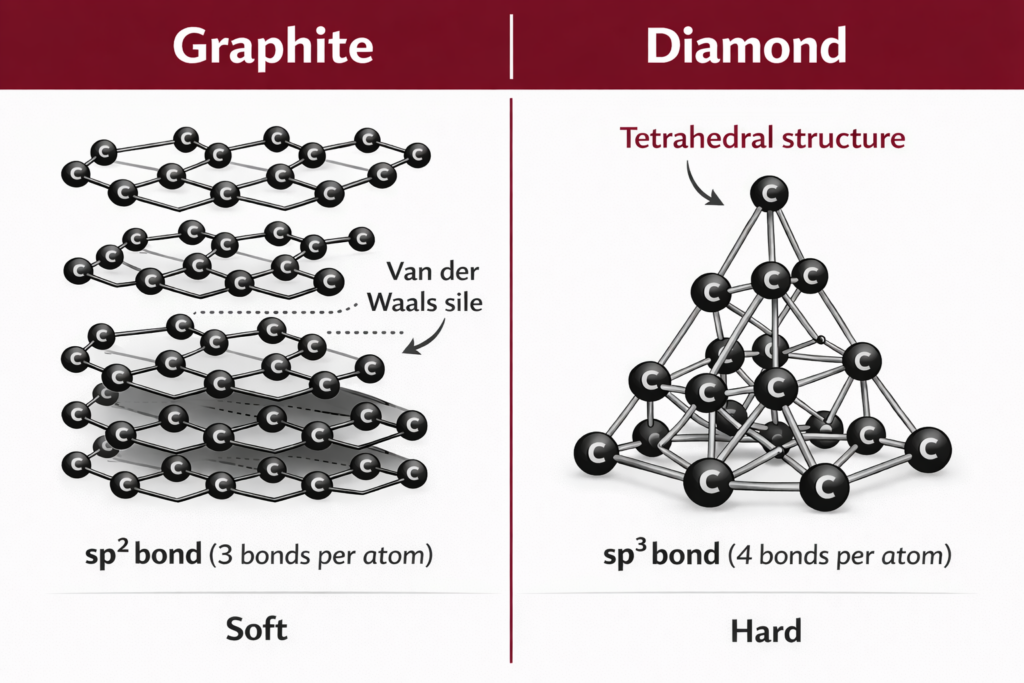
Diamond and graphite are made of the same element — one hundred percent pure carbon. Not a single other atom. No impurities. No additives. Just carbon. In science, this phenomenon is called allotropy — the ability of a single element to exist in completely different forms.
The differences are staggering. Diamond is the hardest natural material on earth, transparent, unreactive, and incredibly valuable. Graphite is soft, black, slippery — so soft it’s used as pencil lead and as a lubricant for machines. One cuts through everything. The other wears away at the first touch.
The only difference is structure. The way the same atoms are bonded and organized. Nothing more.
Same story. Same ingredients. Completely different fate.
We are all the same composition
We are all made of the same “ingredients” — the same basic emotions, the same neurological hardware, the same capacity for growth. When we’re born, we are all pure carbon. Full of potential, with a whole life ahead to decide what we’ll do with what we’re made of. Some become diamond: unbreakable, clear, valuable. Others remain graphite: functional, but soft and weak.
Same element. Same potential. Different structure.
For years people ask me: “How does someone with less than me achieve more?” — and the reverse: “How does someone who has everything achieve nothing?” The answer is always the same, only now I can say it in the language of chemistry: the problem isn’t in the composition. The problem is in the structure.
And this gives me yet another powerful reason to keep saying what I believe: we can all do it.
Four ways structure makes us powerful
Chemistry teaches us four key things about the difference between diamond and graphite. Each is a lesson for life.
1. Full commitment
A carbon atom has four so-called valence electrons. The etymology alone is worth noting: valence comes from the Latin valere — meaning to be strong, to be worth, to matter. Valence electrons are literally the electrons that count — the ones capable of forming bonds. They are the four “hands” with which a carbon atom can hold other atoms, as our teacher Ms. Anđa once explained.
In diamond, every atom uses all four valence electrons to form strong covalent bonds with four neighboring atoms. No disengaged resources. Every hand holds another hand. Every part that counts is invested. In graphite, each atom uses only three. The fourth electron remains uninvested — drifting between layers, in no bond, playing no role. And that one uninvested electron per atom is what makes the entire structure weak.
Now look at these three words in my native Serbian: uloga, uložiti, neuložen — role, to invest, uninvested. They share the same root. How many uninvested electrons do we have — roles we haven’t invested ourselves in? How many of our capacities do we keep “free,” committed to no role, no bond, no goal? Many believe disengagement is freedom. Chemistry says it’s weakness.
Years before writing my books, I began asking people to map out who they truly are. Not just boss, not just mom, not just partner — but everything. Because most of us, I’ve seen it thousands of times, live in what I’d call a graphite structure: we use two or three of our valence electrons while keeping the rest uninvested. We hold tightly to some roles, while leaving others to chance and improvisation. And then we wonder why our lives fall apart under pressure.
We hold tightly to some roles, while leaving others to chance and improvisation. And then we wonder why our lives fall apart under pressure.
2. Resistance to impurities and environment
Diamond’s crystal structure is so densely and precisely organized that impurities literally cannot wedge themselves between atoms. There’s no room for compromise. Diamond stays pure because its structure is so tight that nothing foreign can latch on.
But that’s not all. Diamond is chemically inert — at room temperature it doesn’t react with acids, bases, salts, or corrosive solutions. Not even aqua regia — the acid mixture that dissolves gold — can harm it. Put it in mud, acid, extreme cold, or scorching heat — diamond remains diamond. Wherever you place it, it stays the same.
Graphite is the complete opposite. In chemistry, there’s an entire family of compounds called graphite intercalation compounds — substances that literally squeeze between graphite’s layers and change its properties. Potassium enters between layers and graphite changes color from black to bronze. Bromine enters and its electrical properties shift. Lithium enters — and that’s how lithium-ion batteries work. Graphite becomes whatever its environment inserts into it.
When you truly know who you are — when you add yourself up — shedding what you’re not happens almost automatically. There’s nothing for the foreign to latch onto. Moreover: a person with a solid structure remains the same in any environment. In mud and in comfort, in crisis and in triumph, among critics and among flatterers. A person without structure changes shape depending on who surrounds them — becoming whatever the environment mercilessly inserts between the layers of who they are and who they want to be.
This is perhaps the most important lesson I’ve learned in my work. We hold on to so much because we’ve forgotten who we are without it. That turns out to be chemically accurate: the weaker the structure, the more it lets through and the more it changes under environmental influence. Without an internal filter, without structure, you are who others want you to be — not who you truly are.
Without an internal filter, without structure, you are who others want you to be — not who you truly are.
3. Growth in all dimensions
Diamond’s structure is three-dimensional — every atom is bonded in all directions: up, down, left, right, forward, backward. There are no weak points because there’s no dimension where bonds are missing.
Graphite tells a completely different story. Its bonds are organized in flat layers — surfaces. Within each surface, bonds are strong. But between surfaces? Almost nothing. Only weak forces. These bonds are literally superficial — shallow and porous. That’s why graphite delaminates under pressure: it looks connected, but that connection has no depth.
Most people build in one or two dimensions and think that’s enough. Deep in work, but shallow in relationships. A wide network of contacts, but without depth or true understanding. Progressing in the world around us, but without peace within. These are all superficial bonds — they look impressive but become porous the moment pressure comes from a direction you haven’t covered. A diamond structure demands all three dimensions: depth, breadth, and peace.
Six years ago I wrote: “The path to success runs through a 3D development map made of depth, breadth, and peace.” Depth without breadth is a tunnel — you get stuck in expertise and can’t see the wider world. Breadth without depth is exactly that — a surface. You know a little about everything but nothing thoroughly. We reach diamond-level resilience only when we build in all dimensions simultaneously.
4. Pressure that shapes
Diamonds form 150 to 200 kilometers beneath Earth’s crust, under pressure exceeding 5 gigapascals and temperatures above 1,000 degrees. These extreme conditions force carbon atoms to organize into the densest and most stable structure possible. Graphite forms under far milder conditions. Without that extreme pressure, carbon simply has no reason to organize into diamond form.
The pressure we experience in life isn’t the problem in itself. I often say that vulnerability doesn’t make us weak. We are strong because we are vulnerable. Vulnerability actually makes you stronger. The question is whether we have an internal structure that converts pressure into strength — or whether we crumble under it. Diamond doesn’t form despite pressure. It forms because of it.
Diamond doesn’t form despite pressure. It forms because of it.
Four electrons, four operations
And now I come to something that I found especially fascinating. We said a carbon atom has four valence electrons. Diamond uses all four. My methodology has four basic operations: Addition, Subtraction, Multiplication, Division. My book “Being Successful” has four chapters.
And each operation corresponds precisely to one way diamond surpasses graphite (honestly, this wasn’t intentional):
- Addition = Total commitment. Add up who you are — all of you. Determine your (chemical) composition. Invest all your valence electrons: every role, every capacity, every dimension of yourself. Graphite uses only three. Diamond uses all four. “The good news is — we already are everything. Add up what you carry.”
- Subtraction = Resistance to impurities and environment. Once you’ve added yourself up, subtraction happens almost automatically. A solid structure doesn’t let impurities in and doesn’t change under environmental influence — there’s nothing for the foreign to latch onto. You don’t need willpower to shed excess. You need clarity about who you are. “We hold on to so much because we’ve forgotten who we are without it.”
- Multiplication = Dimensionality of bonds. Build in all dimensions: deeply with yourself, closely with your loved ones, broadly with community, high with purpose. Don’t build superficially. Build in depth, breadth, and height. Every new dimension multiplies your strength. “Success that grows in community grows far faster than individual success.”
- Division = Constructive pressure that shapes. By wisely sharing knowledge, experience, and value, you don’t lose — you multiply. And simultaneously you create constructive pressure that shapes both you and others. Diamond doesn’t form alone. The same goes for people: we grow in communities that challenge us, not in ones that spare us. “Sharing is not a sign of weakness, but the greatest expression of strength.”
Power = to be able
Finally, a word you hear from me often. Power. But not power as domination. For me, power is capability.
Power means you can. If you can do something — you’re powerful. If you can’t — you’re powerless. Simple. No philosophizing.
So when I say “we can all do it” — I don’t mean it as a motivational slogan. We all have potential. We can all do more than we’re doing. The question is only whether we’re committed to everything within our influence — in all our roles, in all dimensions, under pressure that shapes us, with a structure that doesn’t let in what doesn’t belong and doesn’t change depending on who surrounds us or what our circumstances are.
Light (at the end of the tunnel :)
People tell me: “Where’s the room for spontaneity if you have such a rigid system?”
Chemistry answers better than I could. Diamond is transparent. Light passes through it freely — refracting, playing, creating a firework of colors. Precisely because its structure is so perfectly organized, there are no obstacles for light to pass through. Graphite is opaque, dull, black. Light doesn’t pass. In its own chaos and illusion of freedom, it remains impenetrable to what is new, beautiful, and deep.
Structure doesn’t stifle spontaneity. Structure enables transparency and freedom. Chaos, in the end, always creates darkness.
You deserve to be everything you can be
You already have the material. We’re all the same. The same capacities for connection, the same potential that counts, hands that can hold your entire world.
The question isn’t whether you can. You can. We’ve seen that.
The question is whether you’ll decide to invest everything you have. To build in all roles, in all dimensions, not superficially. To embrace the pressure that shapes you. And to remain who you are regardless of who surrounds you and what they try to insert between your layers.
You deserve to be everything you can be. Anything less is too little to devote your entire unique life to.
We are not different in composition. We are different in structure. And structure is not destiny — it’s a decision. Every day, with every choice, with every role you invest in or don’t, you decide whether you’ll be diamond or graphite. You already have the material. Build wisely.
 2020
2020
Comments